Why Modi often targets Nehru in political speeches
Modi’s criticism of Nehru: A political strategy rooted in legacy battles
- By Gurmehar --
- Friday, 01 Aug, 2025
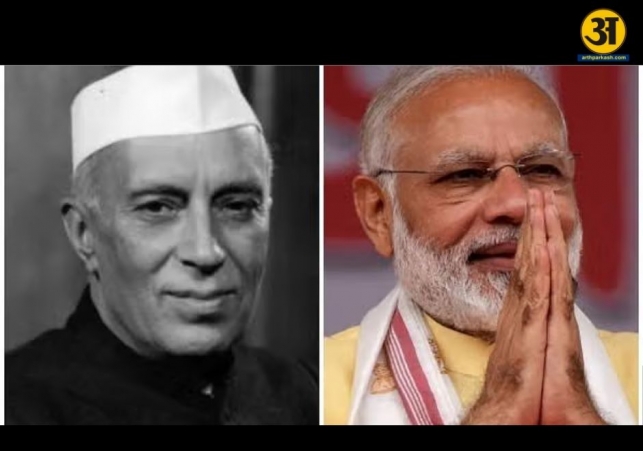
Prime Minister Narendra Modi gave a long speech in the Lok Sabha this week, mostly defending the government’s actions during Operation Sindoor. But what caught everyone’s attention was how often he kept mentioning Jawaharlal Nehru, India’s first prime minister. In just one speech, Modi referred to Nehru 14 times, blaming him for many of India’s present problems.
This wasn’t the first time Modi attacked Nehru—and it likely won’t be the last. For years, Modi has blamed Nehru for everything from Kashmir to socialism to weakening India’s spiritual identity. But the question is: Why does Nehru still bother Modi so much, more than 60 years after his death?
To understand this, we need to look at history—and ideology. Nehru was a firm believer in secularism, science, democracy, and modern values. He wanted India to be a modern, plural, and scientific society, not a religious or theocratic state. His idea of India was inclusive—welcoming all religions, castes, and cultures.
This made him a natural opponent of the Rashtriya Swayamsevak Sangh (RSS), the Hindu nationalist group that shaped Modi’s political beliefs. Nehru saw the Hindutva ideology as dangerous and worked hard to keep religion separate from politics. After Mahatma Gandhi’s assassination by Nathuram Godse, a man linked to Hindu extremist ideology, Nehru’s stance became even stronger.
For the RSS, Nehru was their number one enemy. And Modi, who spent most of his early life inside the RSS, grew up seeing Nehru as a villain—a man who tried to destroy the Hindu nationalist cause.
In his 2008 book Jyotipunj, Modi praised his ideological mentor M.S. Golwalkar, one of the longest-serving RSS leaders. Golwalkar openly opposed Nehru’s modern, liberal policies. In fact, Golwalkar and the RSS believed Nehru was weakening India by not making it a Hindu nation. It’s no surprise, then, that Modi—who deeply respects Golwalkar—continues that battle today.
Congress’s worship of Nehru gave BJP a perfect target
Another reason Modi often brings up Nehru is because of how the Congress party glorified Nehru’s legacy. Instead of treating him as a respected leader with both achievements and flaws, Congress turned him into a larger-than-life figure. Over time, more than 450 public schemes, roads, and institutions were named after Nehru, Indira Gandhi, and Rajiv Gandhi. This led to what some critics call a kind of “family worship.”
In doing so, Congress left little room for honest discussion about Nehru’s mistakes—like the 1962 war with China, or his economic policies. This allowed the BJP to step in and take full advantage of the gaps, painting Nehru as the root of all problems. From removing the Planning Commission to attacking the Indus Water Treaty, Modi’s actions often seem aimed at undoing Nehru’s legacy.
Modi also sees Nehru as a symbol of dynastic politics, even though Nehru himself didn’t try to create a political dynasty. Nehru was succeeded by Lal Bahadur Shastri, not his daughter. It was Indira Gandhi, later on, who made the Congress party into a family affair. But because Nehru is the first in the line, he often gets blamed for everything that followed.
The BJP’s political messaging is smart and sharp. By attacking Nehru, they don’t just attack a historical figure—they challenge the Congress party’s foundation. They make the argument that India must move away from Nehru’s “mistakes” to build a “new India”—one based on cultural pride, Hindu heritage, and nationalism, which is in line with RSS beliefs.
A rivalry that’s about legacy, not just ideology
More than anything else, Modi’s criticism of Nehru is about history and legacy. Modi has now become the longest-serving prime minister in India after Nehru. With Indira Gandhi already behind him in terms of continuous years in office, Nehru is the last big name standing.
Modi sees himself not just as a political leader, but as someone who wants to reshape India in a completely new way. For him, breaking away from Nehru’s India is necessary to build what he sees as a “New India.” In his eyes, Nehru’s legacy is the final obstacle to being remembered as India’s greatest leader.
Modi wants to be seen as the man who made India strong, proud, and powerful again. And to do that, he must take down the tallest figure in India’s post-independence history. This explains why he regularly brings up Nehru’s name in speeches, even if the topic has nothing to do with the past.
But here lies the irony. The more Modi attacks Nehru, the more the public is reminded of Nehru’s importance. Some of Modi’s criticism may be fair, but much of it is one-sided, exaggerated, or based on half-truths. By turning Nehru into a constant punching bag, Modi may actually be giving Nehru more relevance in today’s India than Congress ever could.
ALSO READ: Divya Deshmukh checkmates history to become India’s first Women’s World Cup champion
ALSO READ: Subtle signs of anxiety you might be missing in everyday life
Final thoughts: Time for a balanced view
Jawaharlal Nehru was not perfect. Like all leaders, he had both strengths and flaws. But reducing India’s history to just anti-Nehru narratives is not helpful. India’s progress has come from many different ideas and leaders, including Nehru’s vision of democracy, education, and secularism.
Instead of trying to erase the past, leaders should build on it—fixing what was wrong, keeping what was right, and moving forward. Modi’s desire to make his mark is understandable. But true greatness doesn’t come from destroying others—it comes from creating something better.
It’s time we move beyond blame games and focus on solving real issues: jobs, education, healthcare, and equality. That’s the legacy that will matter in the long run—not just who won the history war.
Related News